Hair tattoo
Hair Tattoo in Perth
Everyone asks the same thing first, and it is not about the procedure. It is whether it will look like a tattoo on your head. Done properly, no — and the difference is almost entirely in the hairline.
Treatment is delivered at our Fremantle clinic.
Fremantle is about twenty minutes south-west of the Perth CBD and the clinic is a short walk from the train line, so most people treat each session as an ordinary appointment rather than a day out.
Hair tattoo · hairline tattoo · bald head tattoo — all names for the same procedure
The hairline is the whole decision
A hairline is the one part of this that people notice consciously. Too straight and too low and it reads as drawn on, every time. The version that works is softer than most people expect: a slightly irregular edge, temple points that recede where yours would have, and a density that fades rather than stops.
The strongest guide is your own history. A photograph from your twenties tells us where your hairline actually sat, which is nearly always better than an idealised line. Age-appropriate does not mean conservative — it means the edge belongs to your face.
Full shave, or blended into what you have
Two quite different looks. The full shaved look treats the whole scalp as one even field of stubble, and it is the most predictable outcome available. Blended density works through remaining hair, reducing the contrast that makes thinning visible.
Which suits you depends less on how much hair you have than on how you want to wear it. People who have already been shaving for years usually know their answer before the first appointment.
Matching stubble, and going grey
Pigment is matched to your hair as it is now, at the depth that reads as stubble rather than ink. Where beard and scalp meet, the transition is worth planning deliberately — a hard line between the two is more obvious than either on its own.
Grey is the honest complication. Pigment does not grey with you, so as surrounding hair lightens the contrast shifts. It is manageable at a refresh, and it is better discussed at the start than discovered later.
Work on real patients
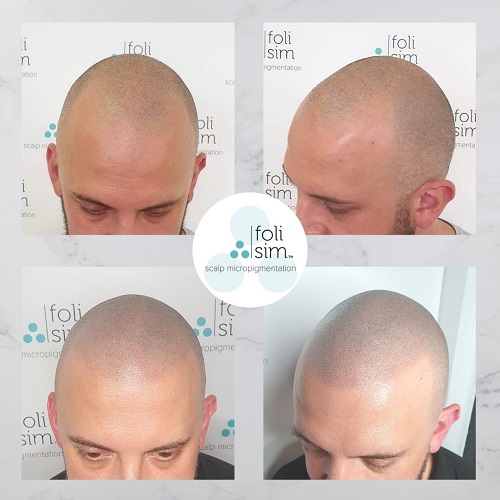
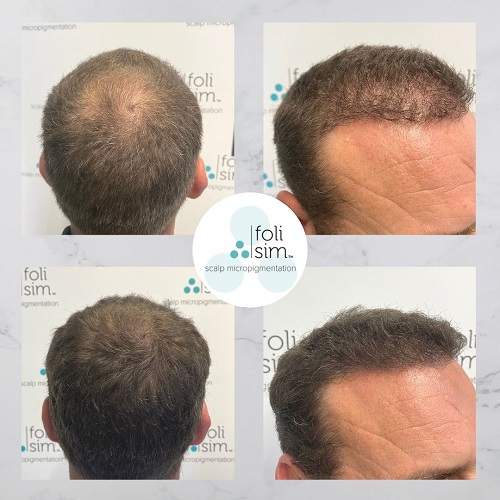

Treatment photography published by Foli Sim, shown unretouched and uncropped as released, with the clinic’s branding in frame. Each set shows the same client before and after their sessions.
These are individual results and are not a prediction of yours. What is achievable depends on the pattern and stage of your loss, your skin, and how the loss behaves from here.
What an assessment establishes
- 1.Which process is causing the loss
Pattern loss, telogen effluvium, traction and scarring alopecia look similar in a mirror and behave nothing alike. The examination separates them, because the answer decides which routes are worth discussing at all.
- 2.Whether it is stable or still moving
Loss that is still progressing changes what any treatment can hold. It is the difference between planning around a fixed area and planning around one that will keep widening, and it is judged from history and examination rather than a single photograph.
- 3.Which routes are available to you, and which are not
Donor supply, scalp condition, skin type and how the loss is behaving each rule options in or out. You leave knowing what is on the table and what is not, without a price attached to the conversation.
5.0 · 564 Google reviewsAcross the Fremantle and North Melbourne clinics
Questions about the look
Will people be able to tell?
At conversational distance, generally not. Very close up, someone looking for it may see impressions rather than hair. The failure mode is a hairline that is too defined, not the pigment itself.
Can I have the hairline I had at 25?
You can, and it usually looks wrong. A hairline appropriate to your face now reads as hair; one borrowed from twenty years ago reads as a decision.
What does it look like as it grows out?
For a shaved look, longer stubble around the pigment starts to compete with it, which is why the look works best kept short.
Does it suit lighter skin tones?
Yes, though the pigment is diluted further and the contrast is handled more carefully. Skin tone affects technique more than suitability.
How does it look in bright light?
Direct sun is the harshest test. Well-placed work holds up; work that is too dark or too uniform shows itself there first.
Can it be softened if I decide it is too strong?
A hairline can be softened, and pigment can be lightened by laser over several sessions. Better to start softer, because adding is easy and removing is not.
Scalp micropigmentation is what Foli Sim delivers. Send photos and get an assessment.
Request an assessment