It is a different job from the men's version
Male pattern loss recedes at the temples and thins at the crown, so the work is usually about a hairline and about covering scalp that has no hair left on it at all. Female pattern loss behaves differently: the hairline is typically preserved and the thinning happens diffusely across the top, widening the part.
That changes what the procedure is doing. Instead of creating the appearance of stubble on bare skin, pigment is placed between the hairs you still have, so the scalp beneath reads darker and shows through less. The hair is doing most of the work; the pigment is removing the contrast that makes the gaps obvious.
The practical consequence is that this only works while there is still hair to blend into. It is a treatment for thinning, not for bare scalp — which is the opposite of the constraint that applies to men.
Who it tends to suit
- A widening part with hair still present either side of it. This is the classic case, and the one where the difference is most visible in photographs.
- Diffuse thinning across the top, where scalp shows through under bright or overhead light more than you would like.
- Someone whose loss has been assessed, so it is understood what is causing it and whether anything treatable is contributing.
- Someone content to keep their current length and style. Nothing about this requires short hair — that constraint belongs to the shaved-look version.
Who it does not suit, plainly
- Anyone hoping for more hair. It adds no hair, changes no follicle and does nothing to the process causing the loss. If the aim is regrowth, this is the wrong page.
- Loss that is still moving quickly. Pigment stays where it is placed while hair continues to be lost, so the result changes underneath you.
- Very advanced thinning with little hair remaining. With nothing to blend into, the result reads as pigment on scalp rather than as density.
- An undiagnosed shedding episode. Telogen effluvium often recovers on its own once the trigger passes. Camouflaging something that was going to resolve is money spent on a problem you did not have.
Why diagnosis comes first here more than anywhere
Female hair loss has a longer list of treatable contributors than male pattern loss does — iron deficiency, thyroid disease, a shedding episode following illness, childbirth or significant stress, and hormonal causes among them. Several of them improve when the underlying cause is addressed.
A cosmetic procedure does not become harder to have because you established the cause first. The reverse is not true: treating something treatable is a better outcome than covering it, and the window in which that works is not indefinite. This is why every honest route into this procedure for a woman starts with an assessment rather than a booking.
Common questions
Can women have scalp micropigmentation?
Yes, though usually as density work rather than the shaved look the procedure is best known for. Pigment is placed between existing hairs to reduce the contrast that makes a part line appear wide and scalp show through. It requires enough remaining hair to blend into, which is why it suits thinning rather than advanced loss.
Do I have to shave my head for scalp micropigmentation as a woman?
No. Density work is done through the hair you already have and you keep your existing length and style. The requirement to wear hair very short applies to the shaved-look version, which is a different application of the same technique.
Will scalp micropigmentation make my hair grow back?
No. It places pigment in the upper layer of the scalp and has no effect on the follicle, on hormones, or on whatever process is causing the loss. It changes how the scalp looks, not what it is doing. If regrowth is the goal, medical treatment works on hair you still have and is a conversation with a doctor.
Is scalp micropigmentation safe if my hair loss is still getting worse?
It is generally safe, but it may not be sensible yet. Pigment stays where it is placed while hair continues to be lost, so a result designed around your current density changes as the density does. Where loss is progressing quickly, understanding why comes first — partly because it may be treatable, and partly because it determines whether the result will hold.
How is SMP for women different from a hair transplant?
A transplant relocates living follicles from the back and sides to where they have thinned, so hair actually grows in the new position. It is surgery, it is limited by donor supply, and diffuse female pattern thinning often makes for a poorer candidate because the donor area may be affected too. Micropigmentation adds no hair at all and simply reduces visible contrast.
References
- Female pattern hair loss — healthdirect Australia
- Female pattern hair loss — DermNet
- Scalp micropigmentation: benefits and side effects — Cleveland Clinic
Work on real patients
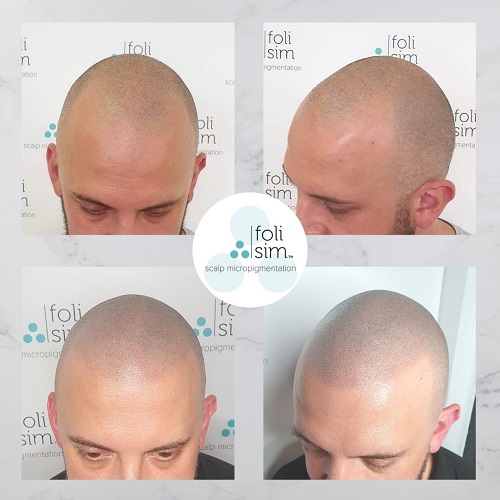
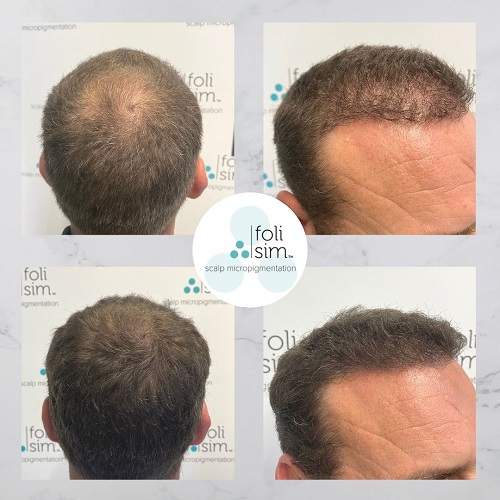

Treatment photography published by Foli Sim, shown unretouched and uncropped as released, with the clinic’s branding in frame. Each set shows the same client before and after their sessions.
These are individual results and are not a prediction of yours. What is achievable depends on the pattern and stage of your loss, your skin, and how the loss behaves from here.
What an assessment establishes
- 1.Which process is causing the loss
Pattern loss, telogen effluvium, traction and scarring alopecia look similar in a mirror and behave nothing alike. The examination separates them, because the answer decides which routes are worth discussing at all.
- 2.Whether it is stable or still moving
Loss that is still progressing changes what any treatment can hold. It is the difference between planning around a fixed area and planning around one that will keep widening, and it is judged from history and examination rather than a single photograph.
- 3.Which routes are available to you, and which are not
Donor supply, scalp condition, skin type and how the loss is behaving each rule options in or out. You leave knowing what is on the table and what is not, without a price attached to the conversation.
5.0 · 564 Google reviewsAcross the Fremantle and North Melbourne clinics