Hair tattoo
Hair Tattoo in Melbourne
The look is decided long before any pigment goes in. Hairline shape, how far back it sits, how sharply it ends — those choices are the result, and they are worth more thought than the technology.
Treatment is delivered at our North Melbourne clinic.
The North Melbourne clinic is on Flemington Road, a few minutes from the CBD and well served by tram, so sessions fit around a working day without much planning.
Hair tattoo · hairline tattoo · bald head tattoo — all names for the same procedure
The hairline is the whole decision
A hairline drawn too low or too straight is the single most recognisable mistake in this work. It is also the most tempting, because a strong line looks impressive in the mirror on the day and wrong in a photograph a month later.
A good line is slightly uneven, has temple points that recede the way yours did, and softens rather than stops. Drawn on and viewed in a mirror before anything permanent happens — if you are unsure, that is a reason to go softer, not to proceed.
Full shave, or blended into what you have
A full shave produces the most even, most predictable result. Blended density is subtler work: it reduces the contrast between pale scalp and darker hair so thinning stops announcing itself, without changing your haircut.
The second is what most people with crown thinning actually want, and it is the option they most often do not realise exists.
Matching stubble, and going grey
Pigment is matched to your current hair and placed to read as stubble. Where a beard meets the scalp the transition needs planning, because an abrupt change between the two is more noticeable than either alone.
Going grey shifts the contrast over time, since pigment does not lighten with you. It is handled at a refresh, and it is a conversation for the start rather than a discovery later.
Work on real patients
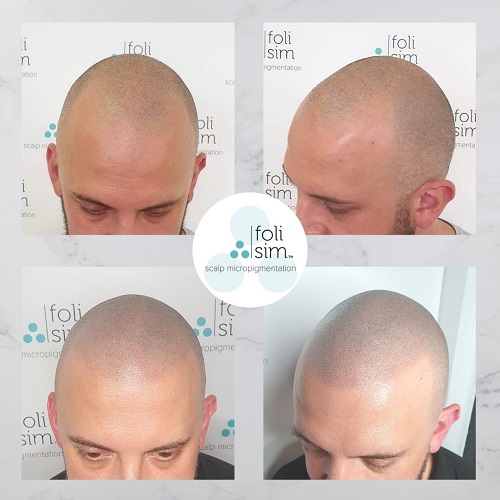
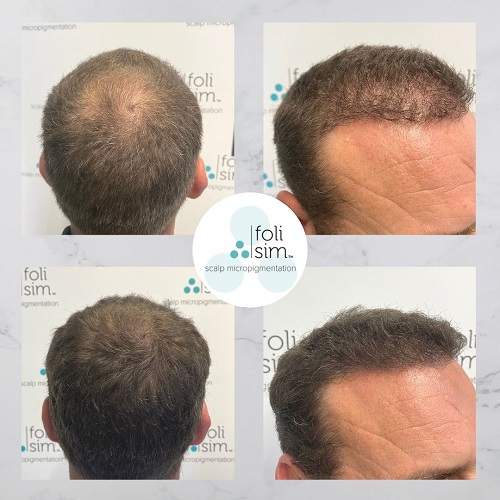

Treatment photography published by Foli Sim, shown unretouched and uncropped as released, with the clinic’s branding in frame. Each set shows the same client before and after their sessions.
These are individual results and are not a prediction of yours. What is achievable depends on the pattern and stage of your loss, your skin, and how the loss behaves from here.
What an assessment establishes
- 1.Which process is causing the loss
Pattern loss, telogen effluvium, traction and scarring alopecia look similar in a mirror and behave nothing alike. The examination separates them, because the answer decides which routes are worth discussing at all.
- 2.Whether it is stable or still moving
Loss that is still progressing changes what any treatment can hold. It is the difference between planning around a fixed area and planning around one that will keep widening, and it is judged from history and examination rather than a single photograph.
- 3.Which routes are available to you, and which are not
Donor supply, scalp condition, skin type and how the loss is behaving each rule options in or out. You leave knowing what is on the table and what is not, without a price attached to the conversation.
5.0 · 564 Google reviewsAcross the Fremantle and North Melbourne clinics
Questions about the look
Will it look obvious in photographs?
Flash photography is the harshest test because it flattens texture. Work that is too dark or too uniform shows there first, which is an argument for restraint.
How short do I need to keep my hair?
For a shaved look, short enough that surrounding hair does not out-compete the pigment — most people settle on a regular clipper length.
Can it cover a scar from a previous transplant?
Often. A linear donor scar can be broken up so it reads as texture rather than a line, though scar tissue holds pigment differently.
What if my hairline keeps receding behind the work?
That is the scenario to plan for rather than hope against, and it is why an age-appropriate line placed conservatively ages better than an aggressive one.
Does it work with longer hair on top?
Density work does, yes — it targets the scalp showing through, not the hair itself.
How do I judge a practitioner’s hairlines?
Ask to see healed work rather than fresh work, ideally at several months. Fresh results always look sharper than they will settle.
Scalp micropigmentation is what Foli Sim delivers. Send photos and get an assessment.
Request an assessment